The Inhuman Intelligence That Already Rules Us
Last week I wrote an essay about how it is the process of an ecologically grounded, collaborative, human-scale art practice that makes it meaningful and fundamentally different from content that is prompted via corporate generative AI systems even though they share the same outcome- a piece of digitized art/content oftentimes distributed algorithmically on an online platform.
I felt compelled to write it partially to give myself and other struggling folks a little pep talk but also because it is an existential time, one where we have to stake out our philosophical positions in the midst of the inevitable ruptures in what it means to be human. The more I read and observe, the more I am convinced that it is the embedded logic of non-stop growth at any cost, reducing the complexity of the world into exploitable data points, and turning humans into addicted, spiritually-broken consumers that we must name and offer alternatives to.
One framework I came across in the introduction of James Bridle’s excellent-so-far book, Ways of Being, is to consider an “alien” intelligence that is already here. These aliens are the largest corporations, private equity firms, and financial institutions. In the USA at least, we have given corporations human rights yet they don’t (easily) die and have a psychopathic need for profit margins. They don’t mind lobbying governments to change safety regulations to poison populations, or outbidding people for huge swathes of housing to create a class of permanent renters. They don’t care about supporting brutal dictatorships in other countries for cheaper resource access. They do not flinch if their medicine is so expensive that people die or have pause when they make profit from number of inmates in a private prison. They do not feel like part of an ecological community, they are not moved to help human flourishing or consider their long term effects on the planet. They are singularly, maniacally focused on metrics that lead to two related outcomes: lower costs, higher profit.
We are only useful to these aliens as workers or consumers. And if our work is getting increasingly automated then our main role will be as disempowered consumers. In an interview about her book Dark Forest Theory of the Internet, media theorist Bogna Konior continues the alien metaphor but argues that we may also remain useful as vectors of training data with everything we do in the open web being used to update LLM systems on human behavior. In a separate lecture she wonders if we have gone from using machines to interface with each other to using each other to interface with machines, a feeling I often get when browsing algorithmically sorted media.
This would be a great time for the government to step in and create privacy laws, to demand transparency and guard rails but in the the tech age these aliens have become more powerful than any government. In the case of the USA our current economy is making an all-in bet on LLM’s and the extractive infrastructure needed to run it. Any attempt at opposing this agenda will cause deep economic harm to almost any citizen who has a retirement account which creates a very strange alliance between exploiter and exploited.
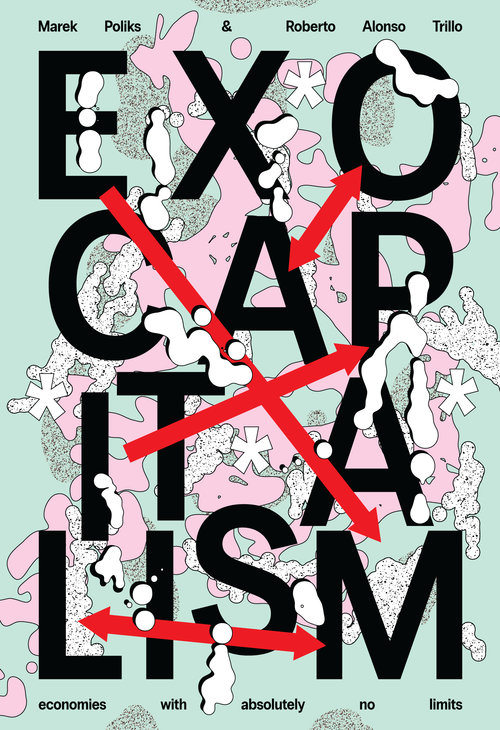
Exocapitalism by Marek Poliks and Roberto Alonso Trillo take the alien metaphor the furthest. The authors argue (though I’m not fully convinced) that capitalism itself is a non-human intelligence who found humans to be the most useful tool towards its goals of endless growth, efficient extraction, and abstraction away from our shared ecological reality. They wonder if we are entering a phase where this exocapitalistic drive is trying to untether itself from the limitations of humanity for something that could be even more efficient with less physical shortcomings. Although the book is quite provocative and makes some fascinating points, I believe we have now found ourselves squarely in actual sci-fi territory.
What I am hoping to show is that these companies ARE making artificial intelligence. But they aren’t artificially emulating the human or ecological kind, instead they are further spreading the narrow, corporate intelligence that only knows how to categorize and plunder, to keep virtualizing and rebuilding the world in a biologically-agnostic image. Untangling ourselves from these systems of exploitation (inside and outside ourselves!) is an important way forward as we find ways to resist the “inevitabilities” that these tech oligarchs promise their stockholders while everyone else wonders “why is this happening?” as their way of life is completely destabilized by an unregulated, uncaring, profit hungry, well… alien entity.
I think a diversity of tactics will be helpful from the inspiring protests over data center building, stronger local communities, a rethinking of how humans and technology can co-exist with ecological systems instead of dominating them, making regulation a major bipartisan issue for politics at all levels of government. But most of all this will require deeps wells of imagination, perspective shifting away from human hubris, and collective reckoning over what a meaningful and compassionate life might look like outside of consumption and experimenting with ways to make it happen right now.