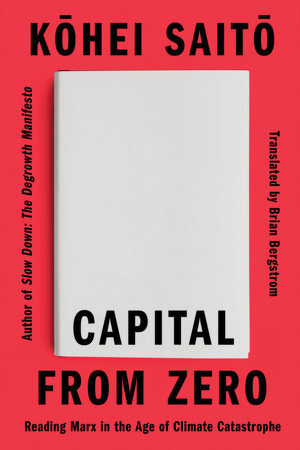
Capital From Zero by Kohei Saito (2026)
I just read Kohei Saito’s new environmental read on Marx’s Capital which might be too simplistic for some but proved to be a great entry point for me since it took the time to define some of ther terms that trip me up in more advanced leftist books.
Saito’s previous book, Slow Down: The Degrowth Manifesto, laid out the case for “degrowth communism” which isn’t the sort of USSR style state-run communism that leads to consolidated power and repression but more like how Marx meant it, where basic needs are “de-commodified” and made by unions of workers in a democratically governed workplace optimized for shorter work hours instead of profit.
This idea of decommodification is very compelling to me as someone who saw water fountains slowly replaced by bottled water while housing and healthcare got more and more outrageously expensive. It is easy to see the ruthless logic of money(or as Marx calls it, exchange value) expanding into every aspect of human life- all the way up to relationships, spirituality, and time itself!
Marx advocated for a system based on the use-value of goods, meaning valuing things by how useful they are to human flourishing instead of exchange-value which makes everything become a commodity that enters a market and often obtains value from marketing more than its use in society. Eventually “the market” forces brutal competition between companies leading to cost cutting, devaluing of labor, and an often inferior product putting corporations in an oppositional role to human flourishing and environmental stewardship.
If the planet can’t support capitalism’s need for infinite growth then it makes sense for Saito to call for de-growth. Obviously that can’t just happen overnight, it is a fundamentally different way of existing for us in the global north. But I do like the idea of starting with what we can control. What are things in our life that can be de-commodified? What brings us a deep feeling of fulfillment, of rest, of connectedness, of spiritual awe, of love? If I had to guess, I’d say these things have nothing to do with sitting at a desk and trying to obtain more commodities.
Instead Saito takes time to separate the idea of societal wealth (things that make a life well lived in a place) versus commodities (when something is given exchange value and then must be exploited) and wants us to pay attention to and protect our societal wealth from commodification.
This book connected some dots for me, especially my recent obsession with untangling the feeling of time with the need to be always doing something productive towards one of my many projects. I’d like to better reorient my energy towards fulfilment, meaning, and connection rather than growth. It would be unbelievably hard but the question is tantalizing: is it possible for our society to consume less, not stress about basic necessities, have a deeply fulfilling and collective life, not exploit the labor of poorer countries, and not overheat the planet at the same time? Kohei Saito says yes.